
Australia Stamp Duty by State (2026–27): Rates, Costs & How to Calculate
Last Updated: 25th March, 2026
Stamp duty (also called transfer duty or conveyance duty) is a state and territory government tax charged when you buy property in Australia. The amount varies significantly by state, property value, and buyer type. In 2025-26, stamp duty ranges from $0 for eligible first home buyers to over $90,000 on a $2 million property in NSW. Each state sets its own rates, thresholds, and exemptions.
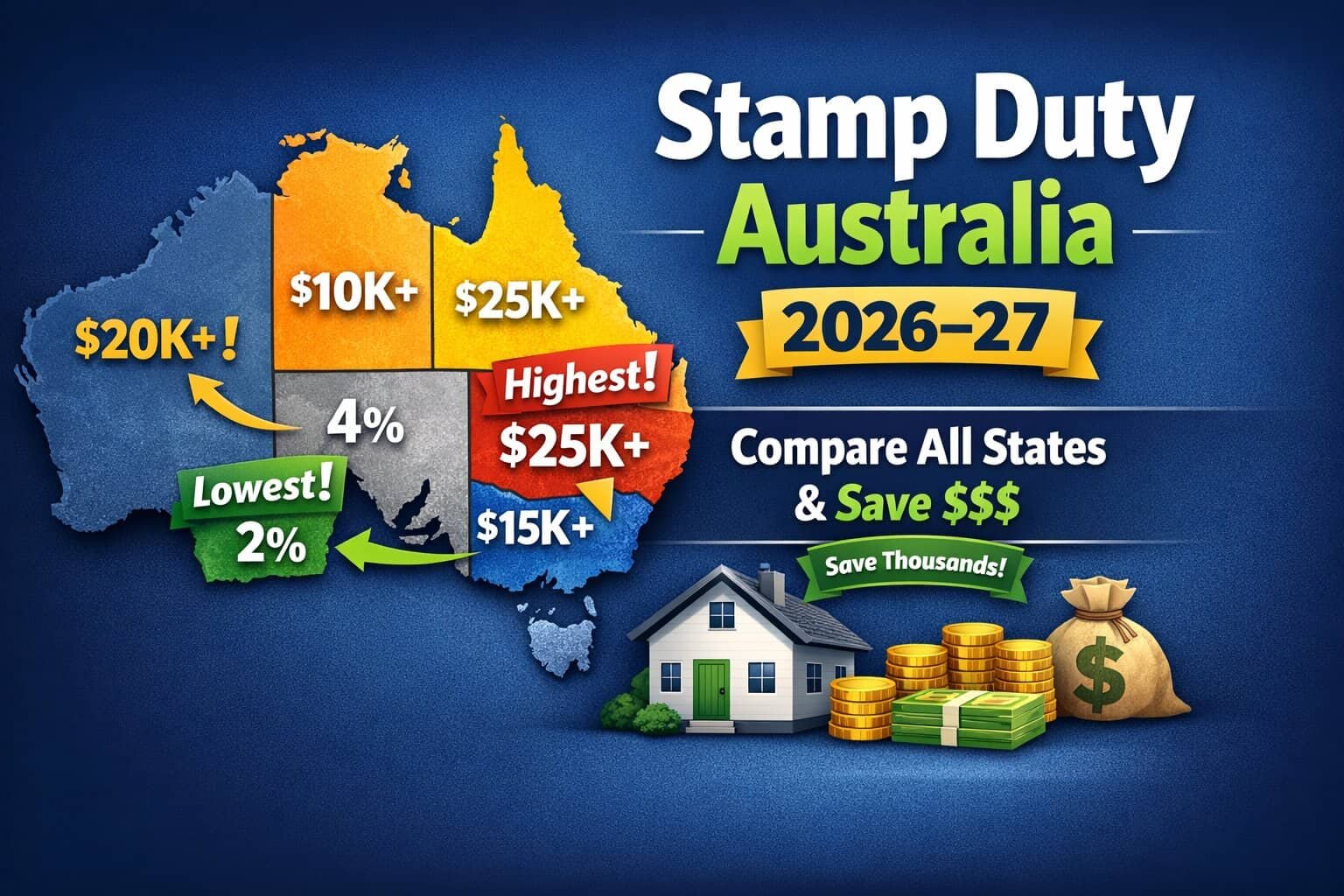
Quick Summary on Australia Stamp Duty by State (2026–27)
- Stamp duty is a state government tax, each of Australia’s 8 states and territories sets its own rates, thresholds, and exemptions.
- First home buyers can save significantly: exemptions range from $0 duty on homes up to $800,000 in NSW to unlimited savings in QLD for new homes (from May 2025).
- Victoria has the highest standard rates at the upper end of the market; Queensland offers the lowest for most property values.
- Investors pay full stamp duty with no concessions in any Australian state or territory.
- Foreign buyers pay an additional surcharge of 7–9% on top of standard rates depending on the state.
- Use our free stamp duty calculator at MyEasyCalculator.com to get an instant, accurate estimate for your property purchase.
Stamp duty is one of the largest upfront costs in any Australian property transaction, and yet it remains one of the most misunderstood. One buyer can pay zero stamp duty while their neighbour pays $40,000 on a nearly identical property, simply because they are in a different state or fall into a different buyer category.
With property prices still elevated across most Australian capitals in 2025, understanding exactly how stamp duty works in your state is not optional — it is essential to your budget and your buying strategy. The 2025-26 financial year has brought several significant changes: Queensland scrapped the price cap for first home buyers purchasing new homes from May 2025, NSW increased its foreign buyer surcharge to 9%, and Western Australia expanded its first home buyer thresholds for the first time in over a decade.
This guide cuts through the complexity. Whether you are buying your first home in Adelaide, an investment property in Melbourne, or a house-and-land package in Perth, this is your complete, state-by-state reference for stamp duty in Australia — updated for 2025-26.
Use the free stamp duty calculator Australia to get your instant estimate before reading on.
What Is Stamp Duty and How Is It Calculated?
Stamp duty — officially known as transfer duty in most Australian states — is a one-off government tax on the purchase or transfer of property. It is collected by individual state and territory governments and goes toward funding public services, infrastructure, and housing programs.
The name dates back to the 1800s, when a physical rubber stamp was applied to legal documents to certify a transaction. While the stamp is long gone, the tax remains — and it now generates over $12 billion per year for state governments in NSW alone.
How Is Stamp Duty Calculated?
Stamp duty uses a progressive (tiered) rate structure, similar to income tax. This means you only pay the higher rate on the portion of the property value above each threshold, not on the entire purchase price.
Example: Progressive Rate Calculation (NSW) Property value: $600,000 Bracket 1 ($0 to $14,000): 1.25% = $175 Bracket 2 ($14,001 to $30,000): 1.5% = $240 Bracket 3 ($30,001 to $80,000): 1.75% = $875 Bracket 4 ($80,001 to $300,000): 3.5% = $7,700 Bracket 5 ($300,001 to $600,000): 4.5% = $13,500 Total stamp duty (standard buyer): $22,490 First home buyer (property under $800,000): $0 |
What Affects How Much You Pay?
The key factors that determine your stamp duty bill are:
- State or territory: The single most important factor. The same property can cost $15,000 more in duty in one state versus another.
- Property value: Higher values mean higher duty, with rates stepping up through brackets.
- Buyer type: First home buyer, owner-occupier, investor, or foreign buyer — each category attracts different rates and concessions.
- Property type: New home, established home, vacant land, or off-the-plan purchase — each can trigger different exemptions.
- Residency status: Foreign buyers pay an additional surcharge of 7–9% on top of standard rates in most states.
Important Note Stamp duty is assessed on the higher of the contract price or the market value of the property. If you buy from a related party or below market value, the revenue office may require a formal valuation and assess duty on market value instead. |
Stamp Duty Comparison: All Australian States at a Glance
The table below compares stamp duty costs for a standard residential purchase (non-first home buyer, owner-occupier) at three key price points across all eight states and territories in 2026-27. This is the data your conveyancer uses when preparing your budget.
State / Territory | $500,000 | $750,000 | $1,000,000 | $1,200,000 | Top Rate |
NSW | $17,029 | $28,162 | $40,070 | $48,412 | 5.5% (+ 7% premium above $3.72M) |
VIC | $21,970 | $40,070 | $55,000 | $66,000 | 6.5% (5.5% flat: $960k–$2M) |
QLD | $8,750 | $24,525 | $34,525 | $43,650 | 5.75% |
WA | $17,765 | $29,365 | $40,615 | $51,790 | 5.15% |
SA | $21,330 | $37,870 | $49,830 | $59,830 | 5.5% |
TAS | $18,248 | $30,248 | $37,248 | $46,248 | 4.5% |
ACT | $8,720 | $20,070 | $29,070 | $36,070 | 4.54% (flat above $1.455M) |
NT | $23,929 | $38,929 | $54,804 | $66,804 | 5.95% |
Source: State Revenue Offices (2025-26). Figures are indicative estimates for standard residential purchases with no concessions applied. Always verify with official state calculators.
Key Insight Queensland has Australia’s lowest stamp duty at most price points. A $750,000 property in QLD attracts around $24,525 in duty vs $40,070 in Victoria — a $15,545 difference on the same property value. However, median property prices vary enormously between states, so the cheapest duty does not always mean the cheapest property purchase. |
Want the exact figure for your property? Use the stamp duty Australia calculator— it covers all 8 states and territories.
New South Wales (NSW) — Stamp Duty Rates and Exemptions 2026-27
NSW generates more stamp duty revenue than any other Australian state — over $12 billion per year. With Sydney’s median house price exceeding $1.1 million, stamp duty is a significant financial hurdle for most buyers.
NSW Standard Stamp Duty Rates (2026-27)
Property Value | Rate | Plus |
$0 to $14,000 | $1.25 per $100 | Nil |
$14,001 to $30,000 | $1.50 per $100 of excess over $14,000 | $175 |
$30,001 to $80,000 | $1.75 per $100 of excess over $30,000 | $415 |
$80,001 to $300,000 | $3.50 per $100 of excess over $80,000 | $1,290 |
$300,001 to $1,000,000 | $4.50 per $100 of excess over $300,000 | $8,990 |
$1,000,001 to $3,000,000 | $5.50 per $100 of excess over $1,000,000 | $40,490 |
Above $3,000,000 | See premium rates | $150,490 |
Source: Revenue NSW (revenue.nsw.gov.au) — effective 1 July 2025.
NSW Premium Property Duty
For residential properties valued above $3,721,000 (the 2026-27 threshold, indexed to Sydney CPI annually), an additional 7% premium rate applies to the portion above the threshold. This is separate from the standard transfer duty.
NSW First Home Buyer Stamp Duty Exemptions
NSW First Home Buyers Assistance Scheme (FHBAS) — 2026-27 Full exemption: Zero stamp duty on new or existing homes valued up to $800,000. Concession: Sliding scale reduction for homes valued $800,001 to $999,999. Vacant land: Full exemption up to $350,000; concession from $350,001 to $449,999. Eligibility: Must be an Australian citizen or permanent resident; never previously owned residential property in Australia; must live in the property for at least 12 consecutive months within the first year. Potential saving: Up to approximately $30,628 on an $800,000 property. |
NSW Home Buyer Choice: Annual Property Tax Option
Eligible buyers purchasing properties up to $1.5 million can choose between paying stamp duty upfront or opting into an annual property tax of approximately $400 per year plus 0.3% of land value for owner-occupiers. This suits buyers who plan to sell within a few years, as the annual tax accumulates over time and typically exceeds the upfront stamp duty cost for those who hold the property long-term.
NSW Stamp Duty Examples
Property Price | Standard Buyer | First Home Buyer | Saving |
$500,000 | $17,029 | $0 | $17,029 |
$750,000 | $28,162 | $0 | $28,162 |
$800,000 | $30,628 | $0 | $30,628 |
$900,000 | $35,628 | ~$17,814 (partial) | ~$17,814 |
$1,000,000 | $40,490 | $40,490 (no concession) | $0 |
$1,200,000 | $51,490 | $51,490 | $0 |
Note: Exact amounts may vary. Always verify with Revenue NSW calculator at revenue.nsw.gov.au.
NSW Foreign Buyer Surcharge Foreign persons (non-residents and certain temporary visa holders) pay an additional 9% Surcharge Purchaser Duty on top of standard transfer duty in NSW. This is Australia’s highest foreign buyer surcharge, raised from 8% to 9% on 1 January 2025. On a $1 million property, this adds $90,000 to the duty bill. |
Victoria (VIC) — Land Transfer Duty Rates and Exemptions 2026-27
Victoria collects stamp duty under the name land transfer duty, administered by the State Revenue Office (SRO Victoria). Victoria is consistently ranked among the most expensive states for stamp duty, particularly for properties in the $960,000 to $2,000,000 range, where a unique flat rate structure applies.
VIC Standard Land Transfer Duty Rates (2026-27)
Property Value | Rate | Notes |
$0 to $25,000 | 1.4% | |
$25,001 to $130,000 | 2.4% | |
$130,001 to $440,000 | 5.0% | Owner-occupier concession applies below $550,000 |
$440,001 to $550,000 | 6.0% | |
$550,001 to $960,000 | 6.0% | Standard rate applies |
$960,001 to $2,000,000 | 5.5% FLAT RATE (on entire value) | Unique VIC rule: applied to full price, not just excess |
Above $2,000,000 | 6.5% | On excess above $2M |
Source: State Revenue Office Victoria (sro.vic.gov.au).
VIC Unique Flat Rate Warning The 5.5% flat rate on properties valued $960,001 to $2,000,000 is applied to the ENTIRE purchase price, not just the marginal excess. A property at $960,001 will attract approximately $52,800 in duty — more than a property at $959,999. Be very aware of this threshold if you are negotiating near $960,000. |
VIC First Home Buyer Duty Exemption and Concession
Victoria First Home Buyer Duty Relief — 2026-27 Full exemption: Zero duty on homes (new or established) valued up to $600,000. Sliding concession: Reduced duty on homes valued $600,001 to $750,000. Key threshold unchanged since 2017: The $600,000 exemption limit has not been indexed to inflation despite significant property price growth in Melbourne. Eligibility: Must be an Australian citizen or permanent resident; never owned residential property in Australia; must move in within 12 months and live there for at least 12 months. Saving at $600,000: Approximately $31,070. |
VIC Off-the-Plan Concession (Expanded Until October 2026)
From 21 October 2024 to 20 October 2026, Victoria expanded its off-the-plan duty concession to ALL buyers — including investors. This means anyone purchasing an apartment, unit, or townhouse in a strata subdivision can have construction costs deducted from the dutiable value. A buyer purchasing a $620,000 apartment off-the-plan could save approximately $28,000 in duty under this concession.
VIC Stamp Duty Examples
Property Price | Standard Buyer | First Home Buyer | Saving |
$500,000 | $21,970 | $0 | $21,970 |
$600,000 | $31,070 | $0 | $31,070 |
$700,000 | $37,070 | ~$24,713 (partial) | ~$12,357 |
$800,000 | $43,070 | $43,070 (no concession) | $0 |
$1,000,000 | $55,000 (5.5% flat) | $55,000 | $0 |
$1,200,000 | $66,000 (5.5% flat) | $66,000 | $0 |
Note: The 5.5% flat rate applies to the entire purchase price for properties valued $960,001 to $2,000,000.
VIC Foreign Buyer Surcharge Foreign purchasers in Victoria pay an additional Foreign Purchaser Additional Duty (FPAD) of 8% on top of standard land transfer duty. On a $1,000,000 property, this adds $80,000 to the total duty payable. |
Queensland (QLD) — Transfer Duty Rates and Exemptions 2026-27
Queensland consistently offers the lowest stamp duty rates of any mainland Australian state — and recent 2025 changes have made it even more attractive for first home buyers. Brisbane has seen significant price growth since 2021, but buyers still benefit from lower transfer duty compared to NSW and VIC.
QLD Transfer Duty Rates — Owner-Occupier (Home Concession)
Property Value | Rate | Plus |
$0 to $350,000 | $1.00 per $100 | Nil |
$350,001 to $540,000 | $3.50 per $100 of excess over $350,000 | $3,500 |
$540,001 to $1,000,000 | $4.50 per $100 of excess over $540,000 | $10,150 |
Above $1,000,000 | $5.75 per $100 of excess over $1,000,000 | $30,850 |
Note: The home concession rate applies to owner-occupiers. Investors pay a higher standard rate, making QLD one of the few states that differentiates between owner-occupiers and investors for standard duty.
QLD First Home Buyer Transfer Duty Concession — 2025 Updates
Queensland First Home Buyer Concession — Updated May 2025 New homes: ZERO transfer duty with no price cap for eligible first home buyers purchasing NEW homes. This change took effect from 1 May 2025 — the most generous first home buyer policy in Australia. Existing (established) homes: Full concession up to $700,000; sliding concession from $700,001 to $800,000. First Home Owner Grant: Queensland offers the highest FHOG in Australia — $30,000 for eligible buyers of new homes (available until June 2026). Eligibility: Must never have owned residential property in Queensland; must be 18 years or older; must be an Australian citizen or permanent resident. |
Key Insight: QLD Is the Best State for First Home Buyers of New Homes Since May 2025, eligible first home buyers in Queensland pay zero transfer duty on new homes regardless of price, and can also claim the $30,000 First Home Owner Grant. On a $600,000 new home, the combined saving compared to a standard buyer is approximately $24,525 in duty plus $30,000 in grants — a total of $54,525. |
Western Australia (WA) — Transfer Duty Rates and Exemptions 2026-27
Western Australia administers transfer duty (stamp duty) through the Department of Finance (finance.wa.gov.au). WA has Australia’s lowest top marginal rate at 5.15%, making it relatively competitive for higher-value properties. March 2025 brought the first threshold increases for first home buyers in over a decade.
WA Transfer Duty Rates (2026-27)
Property Value | Rate | Plus |
$0 to $120,000 | 1.90% | Nil |
$120,001 to $150,000 | 2.85% | $2,280 |
$150,001 to $360,000 | 3.80% | $3,135 |
$360,001 to $725,000 | 4.75% | $11,115 |
Above $725,000 | 5.15% | $28,453 plus… |
WA First Home Buyer Duty Relief — Updated March 2025
WA First Home Owner Rate — Significant 2025 Expansion Perth Metro / Peel: Full exemption up to $500,000; sliding concession from $500,001 to $700,000. Regional WA: Full exemption up to $500,000; sliding concession from $500,001 to $750,000. These thresholds represent the first increase since July 2014 — a major policy change for WA buyers. Eligibility: Must meet the First Home Owner Grant eligibility criteria; intend to live in the property. |
WA Foreign Buyer Surcharge Foreign persons purchasing residential property in WA pay an additional 7% Foreign Buyer Duty on top of standard transfer duty. At 7%, WA’s surcharge is the equal-lowest in Australia alongside South Australia. |
South Australia (SA) — Stamp Duty Rates and Exemptions 2026-27
South Australia administers stamp duty through RevenueSA (revenuesa.sa.gov.au). SA’s rates sit toward the higher end of the national spectrum, but the state has a unique and very generous policy for first home buyers — with one important limitation.
SA Standard Stamp Duty Rates
Property Value | Rate | Plus |
$0 to $12,000 | 1.0% | Nil |
$12,001 to $30,000 | 2.0% | $120 |
$30,001 to $50,000 | 3.0% | $480 |
$50,001 to $100,000 | 3.5% | $1,080 |
$100,001 to $200,000 | 4.0% | $2,830 |
$200,001 to $250,000 | 4.25% | $6,830 |
$250,001 to $300,000 | 4.75% | $8,955 |
$300,001 to $500,000 | 5.0% | $11,330 |
Above $500,000 | 5.5% | $21,330 |
SA First Home Buyer Stamp Duty Exemption — New Homes Only
SA First Home Buyer Policy: Important Distinction New homes and vacant land: Complete stamp duty EXEMPTION with no price cap. First home buyers building or buying a new home in SA pay ZERO stamp duty regardless of the property’s value. Established homes: No exemption available at all. SA is one of only two jurisdictions that provides no concession for first home buyers purchasing established homes. This is a critical distinction: a first home buyer purchasing a $500,000 new home saves $21,330 in stamp duty. The same buyer purchasing a $500,000 established home pays the full $21,330. |
SA Foreign Buyer Surcharge Foreign persons purchasing residential property in South Australia pay a 7% foreign buyer surcharge — equal to WA and the lowest in Australia. |
Tasmania (TAS) — Stamp Duty Rates and Exemptions 2026-27
Tasmania administers stamp duty through the State Revenue Office (sro.tas.gov.au). Tasmania offers Australia’s lowest top marginal rate at 4.5%, making it one of the more affordable states for stamp duty on higher-value properties. For properties under $750,000, Tasmania uses a highly staggered bracket system.
TAS Standard Stamp Duty Rates
Property Value | Rate | Plus |
$0 to $3,000 | Nil | Nil |
$3,001 to $25,000 | 1.75% | Nil |
$25,001 to $75,000 | 2.25% | $385 |
$75,001 to $200,000 | 3.50% | $1,510 |
$200,001 to $375,000 | 4.00% | $5,885 |
$375,001 to $725,000 | 4.25% | $12,885 |
Above $725,000 | 4.50% | Varies |
Tasmania offers a stamp duty exemption for eligible first home buyers purchasing homes valued at $750,000 or less. Buyers should consult the State Revenue Office Tasmania for current eligibility thresholds.
Australian Capital Territory (ACT) — Stamp Duty Rates 2026-27
The ACT (Canberra) is gradually phasing out stamp duty as part of a 20-year tax reform plan that began in 2012. The ACT is replacing stamp duty with increased general rates (land tax) over time. As a result, ACT offers some of Australia’s lowest stamp duty rates for most price brackets.
For the 2026-27 financial year, the ACT Home Buyer Concession Scheme provides full exemption for eligible buyers on properties up to $1,020,000, with a sliding concession to $1,455,000. These thresholds are indexed annually to Canberra’s Consumer Price Index from July 2025 — a world-first automatic indexation mechanism for stamp duty thresholds.
ACT Fact The ACT is the only jurisdiction in Australia that does not charge a foreign buyer surcharge. This makes Canberra uniquely attractive for foreign purchasers. |
Northern Territory (NT) — Stamp Duty Rates 2026-27
The Northern Territory administers stamp duty through the NT Treasury (treasury.nt.gov.au). NT uses a unique formula-based calculation for properties under $525,000, transitioning to standard bracket rates above this threshold. NT has some of the highest effective stamp duty rates in Australia for mid-range properties.
For example, stamp duty on a $500,000 property in the NT is approximately $23,929 — significantly higher than QLD ($8,750) or ACT ($8,720) for the same purchase price. The NT does not currently offer first home buyer stamp duty concessions or exemptions, though exemptions may apply for eligible house-and-land packages in specific circumstances.
First Home Buyer Stamp Duty Exemptions: Complete State-by-State Summary
This is the section that could save you tens of thousands of dollars. Every state except the NT offers some form of first home buyer stamp duty relief, but the thresholds, conditions, and eligibility rules differ significantly.
State | Full Exemption Threshold | Concession Threshold | New Homes Only? | Key Notes |
NSW | $800,000 | Up to $999,999 | No (new and established) | Largest FHB scheme in terms of threshold. Move in within 12 months, stay 12 months. |
VIC | $600,000 | Up to $750,000 | No | Threshold unchanged since 2017. Melbourne median is above exemption limit. |
QLD | No cap (new homes from May 2025) | $700k–$800k (established) | New homes: No cap. Established: Yes cap. | Most generous policy for new homes in Australia. Also offers $30,000 FHOG until June 2026. |
WA | $500,000 | $700k metro / $750k regional | No | Thresholds updated March 2025 — first increase since 2014. |
SA | No cap (new homes/land only) | N/A | Yes — new homes ONLY | No concession for established homes. One of Australia’s most unique policies. |
TAS | Up to $750,000 | Varies | No | Consult sro.tas.gov.au for current eligibility criteria. |
ACT | Up to $1,020,000 | Up to $1,455,000 | No | Highest threshold in Australia. Indexed to CPI from July 2025. |
NT | None | None | N/A | No first home buyer stamp duty exemption currently available. |
Source: State and Territory Revenue Offices (2026-27). Always verify current eligibility with the relevant revenue office before purchasing.
Calculate your first home buyer stamp duty savings instantly using the free stamp duty calculator For the Australia.
Calculate Your Stamp Duty in Seconds Free, instant, accurate — covers all 8 Australian states and territories. |
Stamp Duty for Investors: What You Need to Know
If you are purchasing an investment property in Australia, there is one critical rule that applies in every single state and territory without exception: investors pay full stamp duty, with no exemptions or concessions.
Key Rules for Investment Property Stamp Duty
- No state or territory in Australia offers stamp duty exemptions or concessions for investment property purchases.
- In Queensland, the standard (non-home-concession) transfer duty rates apply to investment properties — typically higher than owner-occupier rates.
- Stamp duty cannot be claimed as a tax deduction in the year of purchase. It is treated as a capital expense.
- Stamp duty does form part of your property’s cost base for Capital Gains Tax (CGT) purposes, which can reduce your taxable capital gain when you sell the property.
- VIC’s expanded off-the-plan concession (until October 2026) is a notable exception — it applies to all buyers, including investors, for eligible strata properties.
Stamp Duty and CGT: What Investors Often Miss
Tax Insight for Property Investors Stamp duty is added to your cost base — the amount you paid to acquire the property for CGT purposes. When you sell, your capital gain is: Sale price MINUS Cost base (purchase price + stamp duty + other acquisition costs). This means $40,000 in stamp duty can reduce your CGT by up to $18,800 (at a 47% marginal rate with the 50% CGT discount applied). Always speak with a qualified tax accountant to understand how stamp duty affects your specific investment strategy. |
Foreign Buyer Stamp Duty Surcharges by State (2026-27)
Foreign persons — generally non-Australian citizens or non-permanent residents — face significant additional stamp duty surcharges when purchasing residential property in Australia. These surcharges are charged on top of standard transfer duty and can add tens of thousands of dollars to the cost of a property purchase.
State | Surcharge | Example: $1M Property | Notes |
NSW | 9% | $90,000 additional duty | Raised from 8% to 9% on 1 Jan 2025. |
VIC | 8% | $80,000 additional duty | Foreign Purchaser Additional Duty (FPAD). |
QLD | 8% | $80,000 additional duty | Non-residents who are not Australian citizens or permanent residents. |
WA | 7% | $70,000 additional duty | Equal-lowest surcharge alongside SA. |
SA | 7% | $70,000 additional duty | Equal-lowest surcharge alongside WA. |
TAS | 8% | $80,000 additional duty | Verify with sro.tas.gov.au for latest rates. |
ACT | None | $0 surcharge | ACT does NOT charge a foreign buyer surcharge. |
NT | None | $0 surcharge | NT does NOT charge a foreign buyer surcharge. |
Note: New Zealand citizens holding a Special Category Visa (Subclass 444) may be exempt from foreign buyer surcharges in some states. Verify with the relevant revenue office.
Strategies to Reduce or Avoid Stamp Duty Legally
There are legitimate ways to reduce your stamp duty bill. These are not loopholes — they are government policies designed to help specific buyer categories.
1. Maximise Your First Home Buyer Exemption
If you are eligible for a first home buyer exemption, ensure your property is priced below or at the threshold for your state. Paying $1 over the NSW $800,000 threshold moves you into a sliding scale concession rather than a full exemption. The saving for staying under the threshold can be significant.
2. Consider Buying Off-the-Plan
In Victoria, all buyers (including investors) can access the expanded off-the-plan concession until October 2026. This allows construction costs to be deducted from the dutiable value, potentially saving $20,000-$30,000 on a typical apartment purchase. In NSW, off-the-plan buyers who intend to owner-occupy can defer payment by up to 15 months.
3. Buy Vacant Land Separately
In most states, stamp duty on vacant land is calculated only on the land value — not the value of the house you plan to build. This can result in substantially lower duty compared to purchasing a completed property. Check your state’s rules on house-and-land packages.
4. Explore the ACT’s Low Rates
If you have flexibility about where you buy, the ACT offers some of Australia’s lowest stamp duty rates and has the highest first home buyer exemption threshold ($1,020,000 in 2025-26). There is also no foreign buyer surcharge in the ACT.
5. Consider NSW’s Annual Property Tax Option
NSW first home buyers purchasing properties up to $1.5 million can opt into an annual property tax instead of upfront stamp duty. If you plan to sell within three to five years, this option can save you the full stamp duty amount upfront. For long-term holders, the accumulated annual payments often exceed the upfront stamp duty.
6. Check for Pensioner and Concession Card Holder Relief
In VIC and several other states, holders of certain Commonwealth concession cards may be eligible for significant stamp duty reductions — in some cases equal to the first home buyer exemption. These concessions are little-known and often overlooked.
Most Common Stamp Duty Mistakes Australian Buyers Make
These mistakes cost buyers thousands of dollars every year. Read this section carefully before you sign a contract.
Mistake 1: Not Budgeting for Stamp Duty at All Many first-time buyers focus entirely on the deposit and forget that stamp duty must be paid separately — it cannot be added to your home loan. A $750,000 purchase in NSW with a 20% deposit requires $150,000 plus $28,162 in stamp duty = $178,162 needed in savings, not $150,000. |
Mistake 2: Assuming First Home Buyer Rules Are the Same in Every State They are not. SA only gives the exemption for new homes. VIC’s $600,000 threshold hasn’t moved since 2017. QLD’s uncapped exemption for new homes is brand new in 2025. Always check the rules in YOUR state before assuming you qualify. |
Mistake 3: The Spouse/Partner Property History Trap In NSW and VIC, you lose first home buyer eligibility if your spouse or de facto partner has ever owned residential property in Australia — even if they are not on the title of the new property. This catches many buyers completely off-guard. Ask your partner to confirm their property ownership history before you apply. |
Mistake 4: Missing the Residency Requirement In NSW and VIC, you must move into the property within 12 months of settlement and live there continuously for at least 12 months to keep your first home buyer exemption. If you fail to meet this requirement and do not notify the revenue office, you may face backdated duty, interest, and penalties. |
Mistake 5: Not Paying on Time Stamp duty is due at or before settlement in most states (NSW gives 3 months from contract signing). Late payment triggers interest charges — in some states exceeding 10% annually — and can cause your settlement to collapse. Your conveyancer should manage this, but always confirm the deadline and payment amount well in advance. |
Official State Revenue Office Resources
Always verify stamp duty rates and your eligibility for concessions directly with the relevant state or territory revenue office before making any property purchase decisions.
State | Revenue Office | Website |
NSW | Revenue NSW | revenue.nsw.gov.au |
VIC | State Revenue Office Victoria | sro.vic.gov.au |
QLD | Queensland Revenue Office | qro.qld.gov.au |
WA | WA Department of Finance | finance.wa.gov.au |
SA | RevenueSA | revenuesa.sa.gov.au |
TAS | State Revenue Office Tasmania | sro.tas.gov.au |
ACT | ACT Revenue Office | revenue.act.gov.au |
NT | NT Treasury | treasury.nt.gov.au |
Final Words about Australia Stamp Duty
Stamp duty is one of the most significant financial considerations in any Australian property purchase, and with rates, thresholds, and exemptions varying so dramatically across the eight states and territories, there is no one-size-fits-all answer.
The key takeaways from this guide:
- Queensland has the lowest rates for most property values; Victoria typically has the highest at the upper end of the market.
- First home buyers can save anywhere from $8,000 to over $30,000 depending on their state and property value — or even more in Queensland for new homes after May 2025.
- South Australia’s exemption for first home buyers applies only to new homes — a crucial distinction that affects thousands of Adelaide buyers every year.
- Investors pay full stamp duty everywhere, but the cost is added to your CGT cost base, providing some long-term tax efficiency.
- Foreign buyers face surcharges of 7–9% on top of standard duty in most states, with only the ACT and NT charging no surcharge.
- The single most important tool in your planning process is an accurate, up-to-date stamp duty calculator.
Before signing any contract, use the Australia stamp duty calculator to get an instant estimate for your state, property value, and buyer type. Then confirm the exact amount with your conveyancer or solicitor before settlement.
Frequently Asked Questions About Stamp Duty in Australia
What is stamp duty in Australia?
Stamp duty (officially transfer duty) is a one-off state and territory government tax on property purchases. The amount varies by state, property value, and buyer type. In 2025-26, rates range from zero for eligible first home buyers to over $90,000 on a $2 million property. It must be paid from savings at or before settlement.
Which Australian state has the lowest stamp duty?
Queensland and the ACT have the lowest stamp duty in Australia for most price points. At $500,000, ACT buyers pay approximately $8,720 and QLD buyers pay $8,750 (with the home concession). At $750,000, Queensland remains cheapest at around $24,525 versus $40,070 in Victoria.
Do first home buyers pay stamp duty in Australia?
Most do not or they pay significantly reduced amounts. NSW exempts first home buyers on purchases up to $800,000. VIC exempts up to $600,000. QLD offers unlimited exemption for new homes from May 2025. SA exempts new homes with no price cap. Only the NT offers no first home buyer stamp duty relief.
What is the stamp duty on a $1 million property in NSW?
The stamp duty on a $1 million residential property in NSW is approximately $40,490 for a standard buyer in 2025-26. First home buyers do not receive any exemption or concession at this price point, as the NSW first home buyer scheme only applies to properties up to $999,999.
How much is stamp duty on a $1.2 million property in NSW?
Stamp duty on a $1.2 million property in NSW is approximately $51,490 for a standard residential purchase in 2025-26. First home buyers receive no concession at this price point. If the purchase is a principal place of residence and the buyer is a foreign person, an additional 9% surcharge of $108,000 would also apply.
Is there stamp duty for first home buyers in Victoria?
Yes, but with generous relief. First home buyers in Victoria pay zero stamp duty on properties valued up to $600,000. For properties priced between $600,001 and $750,000, a sliding scale concession applies. Above $750,000, full standard stamp duty applies. These thresholds have been unchanged since July 2017.
How is stamp duty calculated in Western Australia?
Western Australia calculates transfer duty using a progressive rate structure with a top marginal rate of 5.15% (Australia’s lowest). First home buyers received a significant update in March 2025, with metro buyers now eligible for full exemptions on properties up to $500,000 and concessions up to $700,000. Regional WA buyers get concessions up to $750,000.
Do first home buyers pay stamp duty in South Australia?
In South Australia, first home buyers who purchase a NEW home or vacant land on which they will build are completely exempt from stamp duty with no price cap. However, first home buyers purchasing established homes receive no concession or exemption in SA. This is a critical distinction that is often misunderstood.
Is stamp duty tax deductible for investment properties?
No. Stamp duty on investment properties cannot be claimed as a tax deduction in the year of purchase. It is a capital expense. However, stamp duty is added to the property’s cost base, which can reduce your capital gains tax liability when you eventually sell the property. Speak to a qualified accountant about your specific situation.
Can stamp duty be added to my home loan?
Generally, no. Stamp duty must be paid from your own savings and is due at or before settlement. Some lenders may allow you to borrow up to the stamp duty amount if you have sufficient equity, but this will increase your loan size and the interest you pay over time. Most buyers must have stamp duty funds ready in addition to their deposit.
What is the stamp duty on a $500,000 house in each state?
For a standard residential purchase (non-first home buyer): NSW: ~$17,029. VIC: ~$21,970. QLD: ~$8,750 (home concession). WA: ~$17,765. SA: ~$21,330. TAS: ~$18,248. ACT: ~$8,720. NT: ~$23,929. Queensland and the ACT are significantly cheaper at this price point.
Reviewed By
Reviewed and fact-checked by the editorial team at MyEasyCalculator.com, based on 2025-26 state and territory revenue office guidelines.
Disclaimer
This article is intended for general informational purposes only and does not constitute financial, legal, or tax advice. Stamp duty rates, thresholds, exemptions, and surcharges are complex, vary significantly between states and territories, and are subject to frequent change. The figures and information provided in this guide are based on rates effective as of the 2025-26 financial year.
Before making any property purchase decision, you should verify all stamp duty figures directly with the relevant state or territory revenue office and seek advice from a qualified solicitor, conveyancer, or financial adviser. MyEasyCalculator.com accepts no liability for reliance on the general information contained in this article.