
How to Remove GST from a Price in Australia (Step-by-Step Guide)
Last Updated: 23rd March, 2026
To remove GST from a GST-inclusive price in Australia, divide the total amount by 1.1. This gives you the GST-exclusive (base) price. To find only the GST component, divide the total by 11. Australia’s GST rate is fixed at 10%, so these two formulas handle every standard removal calculation accurately.
Quick Summary on Remove GST from a Price in Australia
- The correct formula to remove GST: Total price divided by 1.1 equals the GST-exclusive price
- To find just the GST amount: Divide the total price by 11
- Never subtract 10% directly from a GST-inclusive price. It produces an incorrect result
- Australia’s GST rate is 10% and has been since 1 July 2000
- Small businesses must apply these formulas accurately for BAS lodgments and ATO compliance
If you have ever stared at a price tag, a supplier invoice, or a BAS worksheet and wondered how much of that total is actually GST, you are not alone. Thousands of Australians, from sole traders to small business owners to everyday shoppers, need to remove GST from a price at some point, and many get it wrong.
The most common mistake? Simply subtracting 10% from the total. It sounds logical, but it gives you the wrong answer every single time.
Understanding how to correctly remove GST from a price is not just a useful skill. For registered businesses, it directly affects your tax reporting, your BAS lodgements, and your financial records. Getting it wrong can lead to overpaying or underpaying the Australian Taxation Office (ATO), which carries real consequences.
This guide walks you through the correct formulas, practical worked examples using real dollar amounts, common errors to avoid, and business-specific scenarios so you can handle every GST calculation with confidence, whether you are working through invoices manually or setting up your accounting software.
What Is GST in Australia?
Understanding GST Basics
GST stands for Goods and Services Tax. It is a broad-based consumption tax of 10% applied to most goods, services, and other items sold or consumed in Australia. The Australian federal government introduced GST on 1 July 2000 under the Howard Liberal Government, replacing a fragmented system of wholesale sales taxes.
Today, GST is one of the most recognised taxes in Australia. Whether you are buying a laptop, hiring a tradesperson, or purchasing stock for your business, GST is built into the price of most transactions.
There are two key pricing structures you will encounter:
- GST-inclusive price: The 10% GST is already included in the total amount shown
- GST-exclusive price: The 10% GST has not yet been added. It is the base price before tax
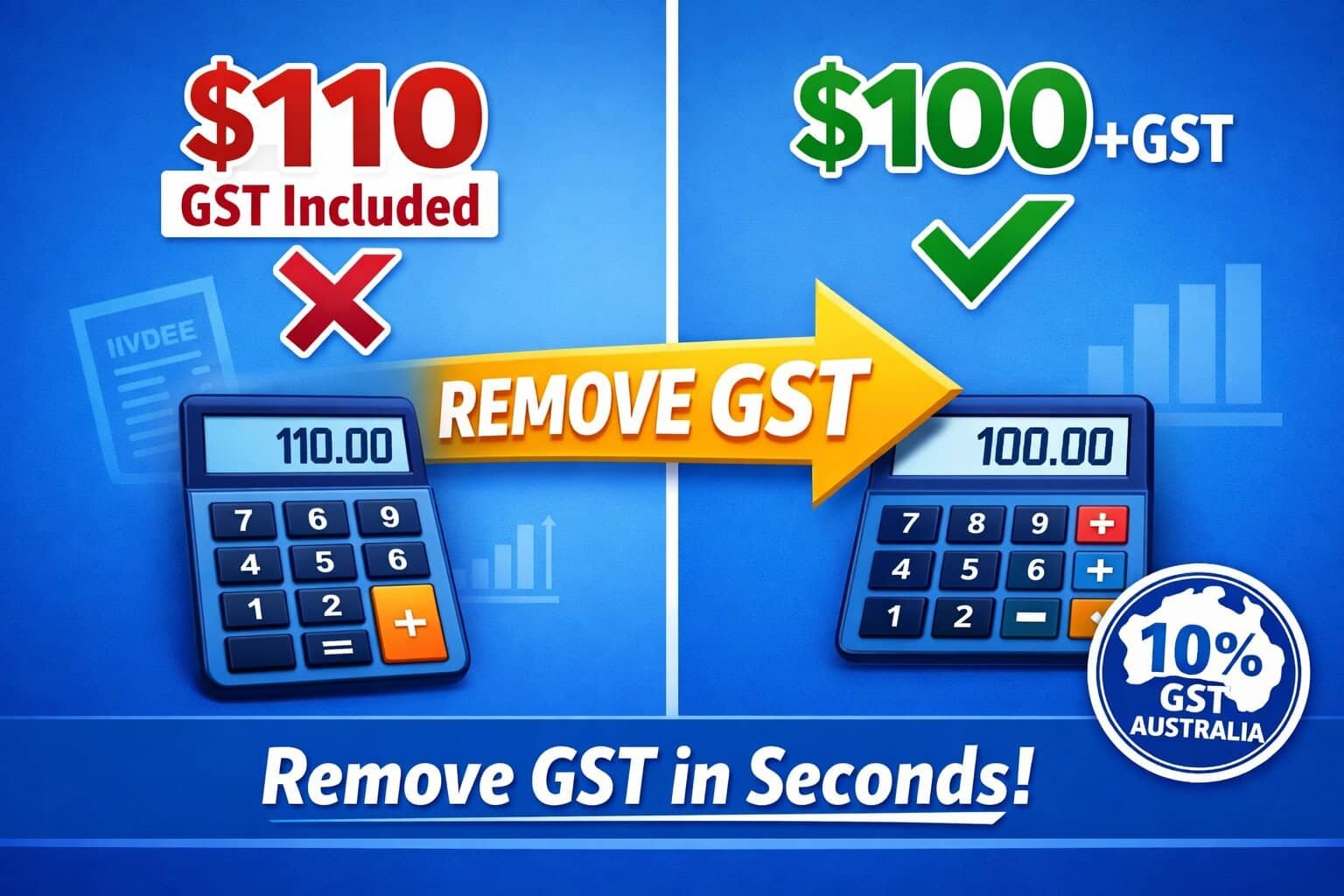
👉 Key insight: When a price tag shows $110, that is GST-inclusive. The actual value of the goods or service is $100. The $10 difference is the GST component.
For a complete and authoritative definition of GST obligations, the Australian Taxation Office (ATO) is the primary reference point.
Why You Might Need to Remove GST
There are several everyday situations where removing GST from a price becomes necessary:
Business accounting and bookkeeping When you purchase goods or services for your business, your accounting records need to separate the base cost from the GST paid. This matters for claiming GST credits.
Invoice preparation and reconciliation When a supplier sends a GST-inclusive invoice, you may need to extract the base amount to record the expense correctly in your accounts.
Pricing strategy decisions Business owners often need to reverse-calculate from retail prices to understand their true margin before GST is applied.
BAS (Business Activity Statement) reporting When lodging your BAS, you report GST collected on sales and GST paid on purchases separately. You need the individual amounts, not just totals.
Personal purchases and comparisons Consumers sometimes need to understand the GST component of a purchase for budgeting or when comparing GST-free versus taxable items.
💡 Tip: If you run a GST-registered business in Australia and your turnover exceeds $75,000 per year (or $150,000 for not-for-profits), GST registration is mandatory under ATO rules. Accurate GST calculations are a legal requirement, not just best practice.
GST Formula to Remove GST from a Price
The Standard GST Removal Formula
The single most important formula you need to know is:
GST-Exclusive Price = Total GST-Inclusive Price ÷ 1.1This works because when a 10% tax is added to a base price, the total becomes 110% of the original. Dividing by 1.1 reverses that operation and gives you back the original base price.
Example:
- GST-inclusive price: $220
- $220 ÷ 1.1 = $200 (GST-exclusive price)
That is it. One simple division. No complex percentages, no mental gymnastics.
Alternative Formula Breakdown
Sometimes you do not need the base price. You just need to know how much GST is buried inside a total. Two sub-formulas handle that.
Extracting the GST Amount Only
GST Amount = Total GST-Inclusive Price ÷ 11This works because GST at 10% forms exactly one-eleventh of the GST-inclusive total. The ATO confirms this “one-eleventh rule” as the standard method for isolating the tax component.
Example:
- Total price: $220
- $220 ÷ 11 = $20 (GST amount)
Finding the Base Price Using Two Steps
If you prefer a two-step approach:
Step 1: GST Amount = Total ÷ 11
Step 2: Base Price = Total - GST Amount
Example:
- Total: $220
- Step 1: $220 ÷ 11 = $20
- Step 2: $220 – $20 = $200 (base price)
Both approaches reach the same answer. The direct division method (total ÷ 1.1) is faster for most people.
Step-by-Step: How to Subtract GST from a Total Amount
Method 1: Using Division (Most Accurate)
This is the recommended approach by accounting professionals and aligns with ATO guidelines.
Example: $150 Including GST
Let’s say you have received a receipt showing a total of $150 including GST. You want to know the base price and the GST portion.
Step 1: Take the GST-inclusive total
Total = $150
Step 2: Divide by 1.1 to get the base (GST-exclusive) price
$150 ÷ 1.1 = $136.36 (GST-exclusive price)
Step 3: Subtract to find the GST component
$150 – $136.36 = $13.64 (GST amount)
Verification check:
$136.36 × 1.1 = $150.00 ✓
💡 Tip: Always verify your removal by multiplying the base price by 1.1. If you get back to the original total, your calculation is correct.
Method 2: Quick GST Extraction Trick
When you only need the GST dollar amount quickly, use the divide by 11 method.
Divide the Total by 11
GST amount = $150 ÷ 11 = $13.64That single step tells you the tax component instantly. From there, subtract from the total if you also want the base:
$150 - $13.64 = $136.36 (base price)Both methods produce identical results. The “divide by 11” approach is popular for quick mental arithmetic, while “divide by 1.1” is better when entering figures into a spreadsheet or accounting tool.
Practical Examples of Removing GST
Example 1: $150 Plus GST
This example works in two directions. First, let’s add GST to a base price, then reverse it.
Adding GST to $150 base price:
$150 × 1.1 = $165 (GST-inclusive price)
Now removing GST from that $165 total:
$165 ÷ 1.1 = $150 (back to the original base price)
The GST component in this case is:
$165 ÷ 11 = $15
This confirms: the base price was $150, the GST was $15, and the total was $165.
Example 2: Finding the Original Price Before GST on an Invoice
A freelance graphic designer in Sydney receives a supplier invoice totalling $418 including GST. She needs to record the expense in her accounting software with the base amount and GST amount separated.
Step 1: Base price = $418 ÷ 1.1 = $380 Step 2: GST component = $418 ÷ 11 = $38 Verification: $380 + $38 = $418 ✓
She records $380 as the expense and $38 as the GST credit she can claim on her next BAS lodgement.
Example 3: Reverse Engineering GST from a Business Total
A Brisbane-based retail business reviews its weekly sales report. Total sales came to $8,800 including GST. The accountant needs the GST-exclusive revenue figure for the income statement.
GST amount: $8,800 ÷ 11 = $800 GST-exclusive revenue: $8,800 – $800 = $8,000
Alternatively: $8,800 ÷ 1.1 = $8,000
The business reports $8,000 as its net revenue and remits $800 to the ATO as part of its BAS.
👉 Key insight: For a GST-registered business, the $800 collected is not income. It belongs to the government. Separating it correctly ensures your profit and loss figures are accurate.
Adding vs Removing GST (Key Differences)
Many people confuse adding GST with removing it. They are opposite operations and use different formulas.
Adding GST to a Price
When you have a GST-exclusive (base) price and need to calculate what to charge the customer:
GST-Inclusive Price = Base Price × 1.1Example:
A plumber charges $250 for labour (exclusive of GST) Invoice total = $250 × 1.1 = $275
Removing GST from a Price
When you already have a GST-inclusive total and need to find the original base:
GST-Exclusive Price = GST-Inclusive Total ÷ 1.1Example:
Customer paid $275 including GST Base price = $275 ÷ 1.1 = $250
Common Mistakes to Avoid
⚠️ Warning: Never subtract 10% directly from a GST-inclusive price
This is the single most widespread GST calculation mistake in Australia.
Here is why it is wrong:
The incorrect approach:
$110 – 10% = $110 – $11 = $99 ← WRONG
The correct approach:
$110 ÷ 1.1 = $100 ← CORRECT
The difference is $1 in this case. On larger amounts, the error compounds significantly. For a $10,000 invoice, the wrong method gives $9,000 while the correct method gives $9,090.91. That $90.91 discrepancy flows directly into your tax records and BAS reporting.
Why does this happen?
When 10% is added to $100, you get $110. The GST is $10, which is 10% of $100 (the base) but only 9.09% of $110 (the total). So when you “reverse” the calculation, you need to account for the fact that you are working from a different base.
The second most common mistake:
Confusing GST-inclusive and GST-exclusive prices on quotes and invoices. If a supplier quotes “$500 plus GST,” the total you pay is $550. If they quote “$500 including GST,” you pay $500 and the GST inside is $45.45.
💡 Tip: Always confirm with suppliers and customers whether a quoted price includes or excludes GST. The difference matters significantly over time.
How to Find GST Exclusive and Inclusive Prices
GST Exclusive Price
A GST-exclusive price is the base price of goods or services before the 10% GST is applied. This is also called the “net price” in accounting.
When you use it:
- On your purchase orders to suppliers
- When calculating your own cost price before adding margin
- When comparing pre-tax prices across different suppliers
- When recording expenses in accounting software (expenses are recorded ex-GST)
Formula to find GST-exclusive price from a GST-inclusive total:
GST-Exclusive Price = Total ÷ 1.1GST Inclusive Price
A GST-inclusive price is the final amount the buyer pays, with the 10% GST already built in.
When you use it:
- On invoices issued to Australian customers (most retail and service businesses)
- When quoting end-consumer prices
- When assessing total costs including tax
Formula to find GST-inclusive price from a base price:
GST-Inclusive Price = Base Price × 1.1Conversion Table (Quick Reference)
Use this table as a fast reference for common amounts:
| GST-Inclusive Total | GST-Exclusive (Base) Price | GST Amount |
|---|---|---|
| $55.00 | $50.00 | $5.00 |
| $110.00 | $100.00 | $10.00 |
| $165.00 | $150.00 | $15.00 |
| $220.00 | $200.00 | $20.00 |
| $275.00 | $250.00 | $25.00 |
| $330.00 | $300.00 | $30.00 |
| $550.00 | $500.00 | $50.00 |
| $1,100.00 | $1,000.00 | $100.00 |
| $2,200.00 | $2,000.00 | $200.00 |
| $5,500.00 | $5,000.00 | $500.00 |
| $11,000.00 | $10,000.00 | $1,000.00 |
💡 Tip: Save or bookmark this table. It covers the most common invoice and retail amounts Australian businesses encounter weekly.
For an instant calculation on any amount, use the free gst tax calculator to remove or add GST in seconds.
GST Calculations for Small Businesses
When You Must Remove GST
For small business owners, removing GST from prices is not optional. It is a compliance requirement tied to several core financial processes.
BAS (Business Activity Statement) Reporting
Every GST-registered business in Australia lodges a BAS either monthly or quarterly. The BAS requires you to report:
- G1: Total sales (GST-inclusive)
- 1A: GST collected on sales
- 1B: GST credits you can claim on purchases
To fill in 1A and 1B correctly, you must remove GST from your total sales and purchases. The ATO does not accept estimates. Your records must be accurate.
Expense Tracking and Bookkeeping
When you record a business expense in your accounting system, you enter the GST-exclusive amount as the cost and track the GST component separately as an input tax credit. Getting this wrong means your profit and loss statement reflects inflated costs, and your BAS claims are inaccurate.
Cash Flow Management
GST collected from customers does not belong to your business. It belongs to the ATO. Business owners who do not separate GST from their revenue can mistakenly spend it, leading to cash flow problems at BAS time. Removing GST from your sales totals regularly keeps this risk visible.
⚠️ Warning: The ATO issued over $1.2 billion in penalties for non-compliance in the 2022-23 financial year, per ATO data. Incorrect GST reporting is one of the most common triggers for audits and penalties for small businesses.
Tools and Methods
Manual calculation
Using the formulas in this guide (divide by 1.1 for base price, divide by 11 for GST amount), you can handle most situations with a basic calculator or even mental arithmetic for round numbers.
Spreadsheet formulas
In Microsoft Excel or Google Sheets:
- To remove GST:
=A1/1.1 - To find GST amount:
=A1/11 - To add GST:
=A1*1.1
Accounting software
Platforms like Xero, MYOB, and QuickBooks handle GST automatically once you set up your tax codes. They separate GST from transaction totals and populate BAS fields without manual intervention. For growing businesses, this is the most reliable long-term approach.
Free online calculator
For quick one-off calculations without opening accounting software, use the GST calculator at myeasycalculator.com. Enter the total, select “remove GST,” and the base price and GST amount are calculated instantly.
Tips for Accuracy
Rounding correctly
The ATO requires GST to be calculated on each transaction and rounded to the nearest cent. Always round to two decimal places. Do not round at intermediate steps in a multi-item calculation. Apply rounding only to the final figures.
Keeping organised records
Every GST transaction needs documentation. Keep copies of all tax invoices for purchases above $82.50 (including GST). For sales, you must issue a tax invoice to any GST-registered customer who requests one, for any sale above $82.50 including GST.
Reconciling regularly
Check that your GST records match your bank statements monthly. Small discrepancies compound over a quarter and create headaches at BAS time.
Advanced GST Scenarios
Reverse GST from Unknown Base Price
Sometimes you receive a payment or see a figure in your accounts and you only know the GST-inclusive total. You need to work backwards to the original base price.
This is simply the standard removal formula:
Base Price = Total ÷ 1.1Scenario: A Melbourne consultant receives a payment of $3,850. She quoted “$3,500 plus GST.” She wants to confirm the amount is correct.
Check:
$3,500 × 1.1 = $3,850 ✓ Or to reverse: $3,850 ÷ 1.1 = $3,500 ✓
The payment is correct.
Scenario 2: An Adelaide electrician looks at a bank deposit of $682 and cannot remember whether he quoted inclusive or exclusive of GST.
If inclusive: base price = $682 ÷ 1.1 = $620, GST = $62 If exclusive: total should have been $682 × 1.1 = $750.20
He checks his quote and invoice to determine which applies. This illustrates why recording whether prices are inclusive or exclusive at the time of quoting is essential.
Calculating GST from Partial Data
What if you know only the GST amount and need to find the total or base price?
Given GST amount, find base price:
Base Price = GST Amount × 10Example: GST = $45 → Base = $45 × 10 = $450
Given GST amount, find total inclusive price:
Total = GST Amount × 11Example: GST = $45 → Total = $45 × 11 = $495
These formulas are useful when reviewing accounting entries where someone has recorded only the tax portion.
Handling Discounts and GST
This is where many business owners make avoidable errors. The order in which you apply a discount versus GST matters.
Scenario: A product has a base price of $200. You offer a 20% discount. What is the final GST-inclusive price?
Correct method: Apply discount first, then add GST
Discounted price = $200 × 0.80 = $160 (GST-exclusive after discount) GST-inclusive total = $160 × 1.1 = $176 GST amount = $176 ÷ 11 = $16
Wrong method: Add GST first, then apply discount
GST-inclusive price = $200 × 1.1 = $220 Discounted total = $220 × 0.80 = $176
In this case, the final figure is the same. However, the GST amount differs:
If you calculated GST on the pre-discount price, you would report:
$220 ÷ 11 = $20 GST
But GST should only apply to the actual price paid after the discount:
$176 ÷ 11 = $16 GST
The ATO requires GST to be calculated on the actual consideration received, which is the discounted amount. Reporting $20 instead of $16 means you are overpaying GST. Over thousands of transactions, this adds up.
👉 Key insight: Always calculate GST on the final net amount after all discounts have been applied.
Common Questions About Removing GST
Is GST Always 10% in Australia?
Yes. Australia’s GST rate has been fixed at 10% since it was introduced on 1 July 2000. There is no reduced rate, no elevated rate, and no regional variation. Unlike some countries that have multiple GST or VAT tiers, Australia applies a flat 10% across all taxable goods and services.
However, not everything is subject to GST. The following categories are GST-free under current ATO rules:
- Most basic foods (fresh fruit, vegetables, bread, milk, meat, eggs)
- Medical and health services covered by Medicare
- Most education services provided by schools, TAFE, and universities
- Exports of goods and services from Australia
- Certain government charges such as road registration fees and passport fees
- Some childcare services
Other categories are “input-taxed,” meaning no GST is charged on the sale but the supplier also cannot claim GST credits on related expenses. This includes residential rent and certain financial services.
For the full and current list, refer directly to the ATO’s GST page for consumer-focused guidance.
Can I Just Subtract 10% to Remove GST?
No, and this is the most important point in this entire guide.
Subtracting 10% from a GST-inclusive price gives you the wrong answer.
Here is a concrete proof:
Start with a base price of $100. Add 10% GST: $100 + $10 = $110 (GST-inclusive total).
Now try to remove GST by subtracting 10%: $110 – 10% = $110 – $11 = $99 ← Incorrect
The correct answer is $100. By subtracting 10% of the total instead of dividing by 1.1, you have introduced an $1 error on every $110.
At $10,000 inclusive, the error is $90.91. At $100,000 inclusive, the error is $909.09.
For business accounting and BAS reporting, this is a material difference.
The only correct formula is:
GST-Exclusive Price = GST-Inclusive Total ÷ 1.1How Do I Calculate GST Quickly Without a Calculator?
For round numbers, the divide by 11 trick is the fastest mental method.
Example with $550:
$550 ÷ 11 = $50 (GST amount) $550 – $50 = $500 (base price)
For most round Australian prices ($110, $220, $330, $550, $1,100), dividing by 11 produces a clean number with no remainder.
For amounts that do not divide cleanly by 11, use a calculator or refer to the quick reference table in this guide.
For any amount at any time, the free tool at GST Calculator performs both addition and removal of GST instantly on any device.
Most Common GST Calculation Mistakes
Even experienced business owners make these errors. Knowing them in advance saves real money and prevents compliance issues.
Mistake 1: Subtracting 10% instead of dividing by 1.1 Already covered above. This single error is responsible for the majority of incorrect GST figures in Australian small business accounting.
Mistake 2: Applying GST to GST-exempt items Some categories are GST-free. Charging 10% GST on fresh food, medical services, or educational courses is incorrect and could expose your business to compliance issues.
Mistake 3: Misidentifying inclusive vs exclusive prices on supplier invoices Always check whether a supplier’s price includes or excludes GST before recording it. “$500” on an invoice that says “plus GST” is not $500 total. It is $550. Entering $500 as the expense and claiming $50 GST credit on a $500 total means you are both understating costs and misclaiming credits.
Mistake 4: Rounding at intermediate steps When processing multiple line items, round only at the final step. Rounding each line mid-calculation creates accumulated errors that do not match your tax invoices.
Mistake 5: Not keeping tax invoices for purchases above $82.50 Without a valid tax invoice, you cannot legally claim the GST credit. The ATO is clear on this. For any business purchase over $82.50 including GST, always request a valid tax invoice showing the supplier’s ABN, the GST amount, and the total.
Best Practices and Strategic Recommendations
For individuals and occasional calculations: Use the divide by 1.1 formula as your default. Verify with the conversion table in this guide for common amounts.
Bookmark the free calculator of Australia GST Calculator for instant access.
For small business owners: Separate GST from every transaction at the time of recording, not at BAS time. Set up proper tax codes in your accounting software. Reconcile your GST accounts monthly so there are no surprises when the BAS lodgement deadline arrives.
For businesses with high transaction volumes: Move to dedicated accounting software (Xero, MYOB, QuickBooks) with automated GST coding. The time saved and the reduction in human error pays for the software subscription many times over.
For BAS preparation: Use the ATO’s online tools and calculators as a cross-check against your own figures before lodging. The ATO’s online services for business portal also allows you to review and correct past BAS lodgements if errors are found.
For pricing strategy: Always be explicit in your quotes and invoices about whether prices are inclusive or exclusive of GST. Add “All prices include GST” or “All prices exclude GST” to every quote template you use.
Mastering GST Calculations
Removing GST from a price in Australia comes down to one formula: divide by 1.1. Everything else in this guide builds on that foundation.
To summarise the core methods:
- Remove GST from a total: Total ÷ 1.1
- Find just the GST amount: Total ÷ 11
- Add GST to a base price: Base × 1.1
- Never subtract 10% directly from an inclusive price
These formulas are not complicated. What matters is applying them consistently, in the right direction, on the right figure. For business owners, that consistency translates directly into accurate BAS lodgements, correct financial records, and no unexpected conversations with the ATO.
Whether you are calculating manually, using a spreadsheet, or running dedicated accounting software, the underlying logic is the same. Master these formulas and GST will never be a source of confusion again.
For a fast, accurate, free calculation at any time, visit GST Calculator AU and use the built-in GST calculator to add or remove GST in a single click on My Easy Calculator for free.
Common Questions (FAQ) about How to remove GST from a price
How to remove GST from a price?
To remove GST from a price in Australia, divide the GST-inclusive total by 1.1. For example, $110 ÷ 1.1 = $100. To find just the GST component, divide by 11: $110 ÷ 11 = $10. Australia’s GST rate is fixed at 10%.
How to find base amount from GST amount?
To find the base amount from the GST amount, multiply the GST by 10. Since GST is 10% of the base price, the base is always 10 times the GST amount. For example, if GST = $25, the base price = $25 × 10 = $250. The GST-inclusive total = $25 × 11 = $275.
How do I subtract GST from a total amount?
To subtract GST from a total amount in Australia, divide the GST-inclusive price by 1.1. This gives you the base price before GST. For example, $220 ÷ 1.1 = $200. Alternatively, divide by 11 to find just the GST component ($220 ÷ 11 = $20), then subtract that from the total.
What is the formula for a GST-exclusive price?
The formula is: GST-Exclusive Price = GST-Inclusive Total ÷ 1.1. This is the standard ATO-aligned method for removing the 10% GST from a total price. For quick mental checks on round numbers, you can also use: GST amount = Total ÷ 11, then Base price = Total – GST amount.
How do I get the GST amount from a total price?
Divide the total price by 11. This works because GST at 10% is exactly 1/11th of the GST-inclusive total. Example: $330 ÷ 11 = $30 GST. The base price is $330 – $30 = $300. You can verify this by checking that $300 × 1.1 = $330, which confirms the calculation.
Can I remove GST by subtracting 10% from the total?
No. Subtracting 10% from a GST-inclusive total gives the wrong answer. For example, $110 – 10% = $99, but the correct base price is $100 ($110 ÷ 1.1). The error occurs because GST is 10% of the base price, not 10% of the total inclusive price. Always divide by 1.1, never subtract 10% directly.
Reviewed By
This article has been reviewed by the editorial team at MyEasyCalculator, referencing current Australian Taxation Office guidelines, Moneysmart.gov.au resources, and ATO BAS reporting requirements as of March 2026.
Sources consulted:
- Australian Taxation Office: GST
- ATO: Tax invoices
Disclaimer
The information in this article is provided for general informational purposes only. It reflects current Australian GST rules as of the date of publication but does not constitute financial, legal, or tax advice. GST rules can change, and individual circumstances vary. For specific advice relating to your business or tax obligations, consult a registered tax agent or accountant. The ATO website at ato.gov.au is always the authoritative source for Australian tax rules.